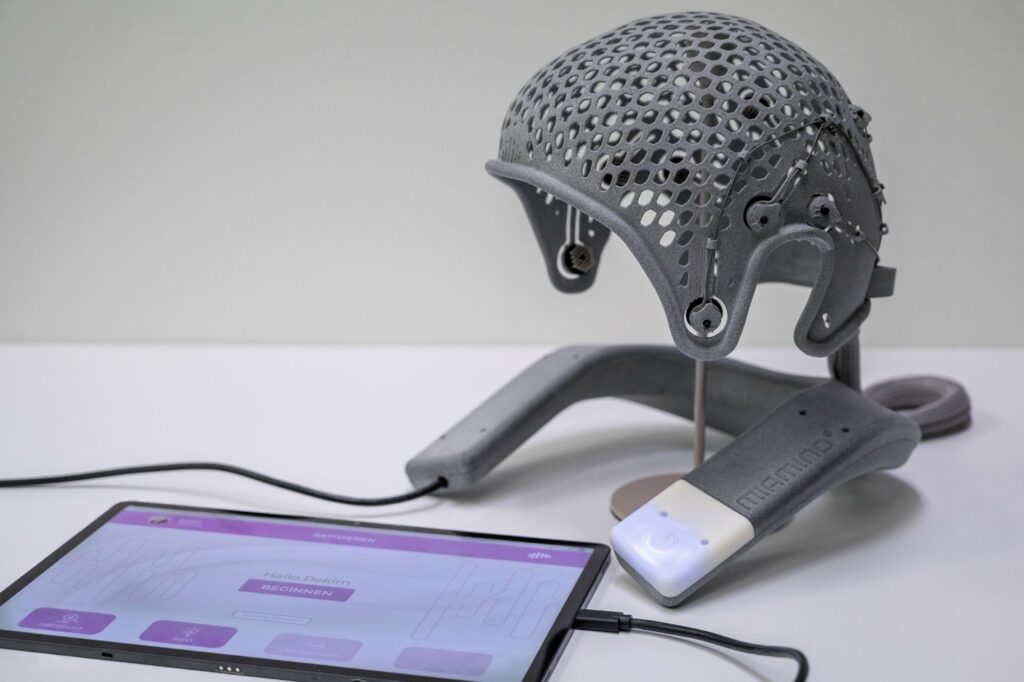
Swiss medtech company Bottneuro is starting a three-year clinical trial with its MIAMIND® neurostimulator, testing personalised brain stimulation as a home therapy for early-stage Alzheimer’s disease. The project is funded by Innosuisse.
The Problem Nobody Has Solved Yet
An early Alzheimer’s diagnosis still leaves most patients with limited options. Drug treatments offer modest benefits. Specialist therapies are hard to access. For many people, the nearest clinic is an hour away.
Bottneuro built MIAMIND® with this reality in mind. The device delivers non-invasive electrical brain stimulation that patients can administer themselves at home. What sets it apart: the stimulation is guided by each patient’s own MRI data, targeting the exact brain regions that need it. No other device on the market does this. The question now is whether it works at scale. That’s what this trial is designed to find out.
How the Study Works
The project is titled “Personalised Transcranial Electrical Stimulation Therapy at Home for Early-Stage Alzheimer’s Disease” and runs for three years with Innosuisse backing. It is set up as a randomised, sham-controlled trial: some participants receive real stimulation, others a non-active placebo treatment. Nobody knows which group they’re in until the trial ends.
Five questions are on the table:
Memory: Does episodic memory actually improve after four weeks of treatment at home?
- Biological change: Can the stimulation measurably alter cerebral blood flow and brain connectivity?
- Treatment monitoring: Which biomarkers are most useful for tracking how therapy is going?
- Patient selection: Who benefits most? Identifying this early avoids wasting treatment on patients unlikely to respond.
- Cost and coverage: Is MIAMIND® cost-effective enough that insurers could justify reimbursing it?
Already Approved. Already in Use.
MIAMIND® holds regulatory clearance in Switzerland as a custom-made medical device and is already being used in clinical settings. That shortens the path considerably. If the trial delivers strong results, there is no years-long gap before patients see the benefit. The infrastructure to act on good data is already in place.
The Team Behind It
Prof. Jessica Peter at the University of Bern leads the scientific side. She has spent years working on Alzheimer’s, neuromodulation, and neuroimaging. Bottneuro brings the technology, the regulatory track record, and the commercialisation strategy.